Online Training, Guidance and Good Practice
Resources for Supporting Students with Disability in VET
This implementation guide has been developed for leaders of Registered Training Organisations (RTOs). It introduces a refreshed set of ADCET resources that support RTOs to support and enable students with disability in vocational education and training (VET). These resources have been updated to align with the 2025 Standards for Registered Training Organisations, which came into effect on 1 July 2025 and bring accessibility and student support into everyday quality practice. This guide explains what each resource is, who it is for, and how it can help you strengthen inclusive practice and support students with disability at your organisation.
In this resource, we will cover:
- Information about students with disability in VET and the Standards
- The resources, and how they can help you
- How to access and implement the resources
The Implementation Guide can be downloaded in full in either PDF or Word, and the content from the Implementation Guide follows underneath the downloadable guides.
Download: Implementation Guide (doc) Download: Implementation Guide (pdf)
Overview
ADCET has undertaken a program of work funded by the Department of Education and Workplace Relations (DEWR) to refresh its suite of VET resources to help RTOs build capability in supporting students with disability. The update included reviewing two existing eLearning programs to better align with the 2025 Standards for RTOs and the creation of new good practice case studies from practitioners in VET, alongside updated guidance on VET data. A new VET landing page on adcet.edu.au brings these together with existing resources as a central point for information on disability inclusion in VET, at www.adcet.edu.au/VET.
These updates have occurred at an important time. Students with disability continue to take part in, and complete, VET at lower rates than population representative data and experience poorer employment outcomes after training than students without disability. Bridging this divide depends on improving student experience, building staff and organisational practices and capability, and implementing good practice across the whole student lifecycle, from the first enquiry through to completion and the move into work.
The national picture shows the scale of the gap[ 1]:
- In 2024, students with disability were recorded as 4.0% of domestic VET students aged 15 to 64 under Australia’s Disability Strategy participation indicator, showing little change from 4.4% in 2021. By comparison, the Australian Bureau of Statistics estimated that 15.7% of people aged 15 to 64 had disability in 2022.
- For qualifications commenced in 2020, the four-year completion rate was 40.9% for students with disability, compared with 49.1% for students without disability.
- In 2025, 57.0% of VET graduates with disability were employed after training, compared with 78.1% of graduates without disability.
This data shows that there is an ongoing need for targeted and high-quality supports, service and infrastructure design (both digital and physical) for students with disability in VET.
What the 2025 Standards mean for disability inclusion
The 2025 Standards for Registered Training Organisations (the Standards) take an outcomes and quality based approach and bring accessibility, support for students with disability, diversity and inclusion, and student wellbeing into the core Outcome Standards.
The Standards expect RTOs to:
- Provide engaging, well-structured training including training that is connected to industry, employer and community representatives.
- Provide an assessment system that is consistent with the training product, is quality assured, and assessments are conducted in a way that is fair and appropriate, enabling a fair and true assessment of student competency.
- Support students to have their prior learning recognised and obtain credit transfers.
- Provide resources, equipment and facilities that are fit-for-purpose, accessible, safe, and sufficient.
- Provide students with access to clear and accurate information about the organisation, training products, and any changes that may impact the student.
- Students are informed and advised prior to enrolment about the suitability of training products for their individual circumstances, including considering the students skills and competencies.
- Students are provided access to support services, trainers and assessors with the objective of supporting their training progress.
- Students with disability are enabled to access and participate in their training on an equal basis through the provision of reasonable adjustments.
- Learning environments support and promote the diversity of VET students, including ensuring wellbeing needs of students are identified and appropriate strategies are in place.
- Feedback and complains have a robust continuous improvement process, and feedback and complaints management addresses concerns raised by students.
- There are effective appeal processes that students can use where decisions of the RTO or a third party adversely affect the student.
- That workforces are effectively managed, training and assessment is delivered by appropriately skilled and credentialed staff, and training and assessment is delivered by staff with industry knowledge and skills that are current and relevant to the training product.
- Appropriate governance frameworks are in place to ensure the RTO operates with integrity, is accountable and that staff have clearly defined roles and responsibilities.
- Risks to students, staff and the RTO are identified and managed, and monitoring and evaluation of the organisation is undertaken to support continuous improvement and the delivery of quality training.[2]
When implementing these requirements, RTOs should do so while considering existing obligations under the Disability Discrimination Act 1992 (DDA) and the Disability Standards for Education 2005 (DSE). The DSE requires education and training providers to take reasonable steps to enable students with disability to participate in education on the same basis as students without disability, including through the provision of reasonable adjustments. Reasonable adjustments are a legal requirement and now part of the quality practice the Standards expect, and importantly, the 2025 Standards for RTOs point toward an approach of inclusive design.
For example, a requirement to Provide resources, equipment and facilities that are fit-for-purpose, accessible, safe, and sufficient would require considerations as to the accessibility for students with disability of buildings, ICT, and communication prior to a request for a reasonable adjustment. The Standards represent an opportunity for RTOs to build accessibility directly into the design of training locations, delivery, processes, equipment, buildings, ICT, communications and staff capabilities.
ADCET’s refreshed resources are designed to help you meet these expectations, including a focus on implementing accessibility by design: building inclusion into your systems, information and teaching, building staff capability, and adopting Universal Design for Learning (UDL).
The resources, and how they help you
In this section we’ll unpack each resource and explain who it is for, and how it can support implementation of the Standards in your organisation.
ADCET Academy eLearning programs
ADCET Academy provides free, online professional development to support inclusive education and improve outcomes for students with disability. Two VET eLearning programs have been reviewed and updated to reflect the 2025 Standards:
- Supporting Students with Disability in VET (Staff) – focuses on promoting awareness about the rights of students with disability, the needs and requirements of students, and responsibilities of registered training organisations.
- Supporting Students with Disability in VET (Educators) – focuses on promoting a range of practices such as Universal Design for Learning and reasonable adjustments, to support the development and implementation of inclusive delivery and assessment strategies, responsive to the needs and requirements of students with disability.
How it helps: completing the relevant programs are a practical way to build the staff capability the Standards expect, and to record professional development in disability inclusion as part of your continuing professional development planning.
The eLearning packages have SCORM files available for your organisation to download and embed in your own Learning Management Systems, or they can be completed online through ADCET Academy. Participants can download a Certificate of Completion along with a unique digital badge for email or Linked profiles.
Resources to support VET students with disability
Developed by ADCET in collaboration with the VET and disability sectors and funded by the Australian Government Department of Employment and Workplace Relations (DEWR), this suite helps RTOs become more inclusive of people with disability and mental health conditions.
These resources include:
- an introductory guide
- practice guides
- practice illustrations
- supporting resources for the practice guides and illustrations
- guidelines for inclusive enrolment practices in VET
Spanning the student journey: pre-enrolment, enrolment, transition from school, reasonable adjustments, participation and accessibility, progress and completion, and practice improvement and reflection, the content draws on the 2020 Review of the Disability Standards for Education 2005[3], the 2025 Standards, recent research and industry reports, the experience of VET staff and practitioners, and guidance from sector specialists.
The resources are available on DEWR’s website
How it helps: the practice guides and illustrations give your teams examples for each stage of the journey, supporting consistent, confident practice across the areas the Standards address.
Good practice case studies
The case studies show how educators, practitioners and staff within RTOs across Australia are supporting students with disability in real world scenarios.
Topics include:
- supporting students’ mental health
- providing tutorial support through the Disabled Australian Apprentice Wage Support (DAAWS)
- using technology to support students
- embedding Universal Design for Learning (UDL) in trades training
- supporting student transitions to TAFE
- bringing the workplace onto campus
- creating future UDL leaders
How it helps: the case studies give leaders and staff practical, sector-tested examples to consider and adapt into their own practice.
VET data for decision making
This resource provides guidance on using national VET data to understand, evaluate and improve access and outcomes for students with disability across the sector. National data lets providers examine how students with disability are recorded, and how their completion and employment outcomes compare with those of other students.
How it helps: the resource guides you to apply the same lens to your own organisation’s enrolment, completion and outcomes data, so you can set priorities and measure progress over time – which supports the monitoring and continuous improvement focus of the Standards.
Access Plans for VET educators
The Access Plans for VET Educators are a comprehensive and adaptable suite of professional learning resources that you can contextualise to your organisation and teams. They include presentations and a session guide to enable RTOs to deliver up to a 2-hour professional learning session on what educators do when they receive a student’s access plan.
The session builds VET educators’ understanding of their roles and responsibilities in developing and implementing access plans, and a broader, deeper understanding of reasonable adjustments and the range of supports available. This can strengthen educators’ confidence in professional conversations and help students engage with, and manage, their own plans.
How it helps: the session gives you a ready-made way to build educator capability around reasonable adjustments – a core expectation of the Standards and a requirement under the DSE.
Other Support
ADCET has a range of free services and networks to help support educators and staff to share, improve and solidify their practice.
These include:
- Communities of Practice for Assistive Technology, Supporting Neurodivergent Students and Universal Design for Learning.
- ADCET UDL Studio – a fortnightly drop-in session for staff to come and discuss the implementation of UDL and inclusive practice.
- ADCET Assist – 1:1 and small group sessions to assist educators and disability support staff with queries relating to digital accessibility, inclusive teaching, and assistive technology.
How to access the resources
The VET landing page
A new VET landing page on ADCET brings together all these VET resources as a central point for information on disability inclusion in VET: www.adcet.edu.au/VET
Promoting the resources within your organisation
The following have been developed to assist RTO leaders to encourage their staff to engage in the resources:
- An email template with direct links
- Poster templates that help promote the training and resources that can be printed or shared digitally
- Access to SCORM files if you would like to embed the training into your own Learning Management System.
- Some next steps for leaders to support organisational adoption of the resources.
An email to share with your staff
The following is a short email you can adapt and send to your team. This is likely to have more impact if it comes from senior leadership within your organisation.
Note: Replace the bracketed details before sending.
Subject: New resources to support students with disability in VET
Hi team,
As you are aware, supporting students with disability is a focus area within the revised 2025 Standards for Registered Training Organisations. To support this, the Department of Education and Workplace Relations (DEWR) engaged ADCET to update resources to assist RTOs in designing & delivering inclusive education in VET. There are two updated eLearning programs – one for educators and one for wider VET staff – along with new good practice case studies from educators and staff across the sector, and other information on supporting students with disability in VET.
Please take some time to explore the resources and complete the eLearning that fits your role. You can find everything on www.adcet.edu.au/VET. If you have any questions, contact [name or team].
Thanks,
[Your name]
Poster templates
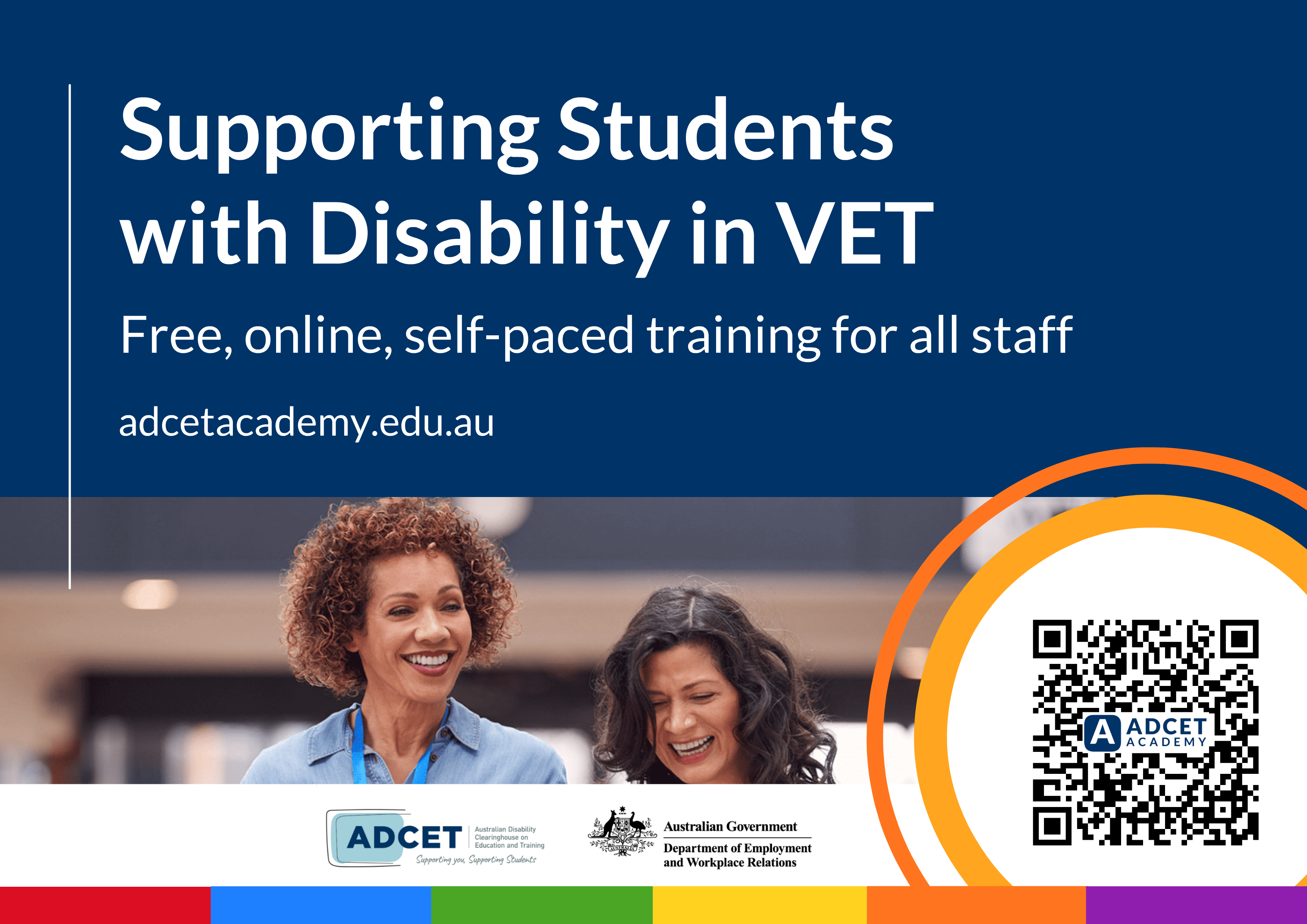
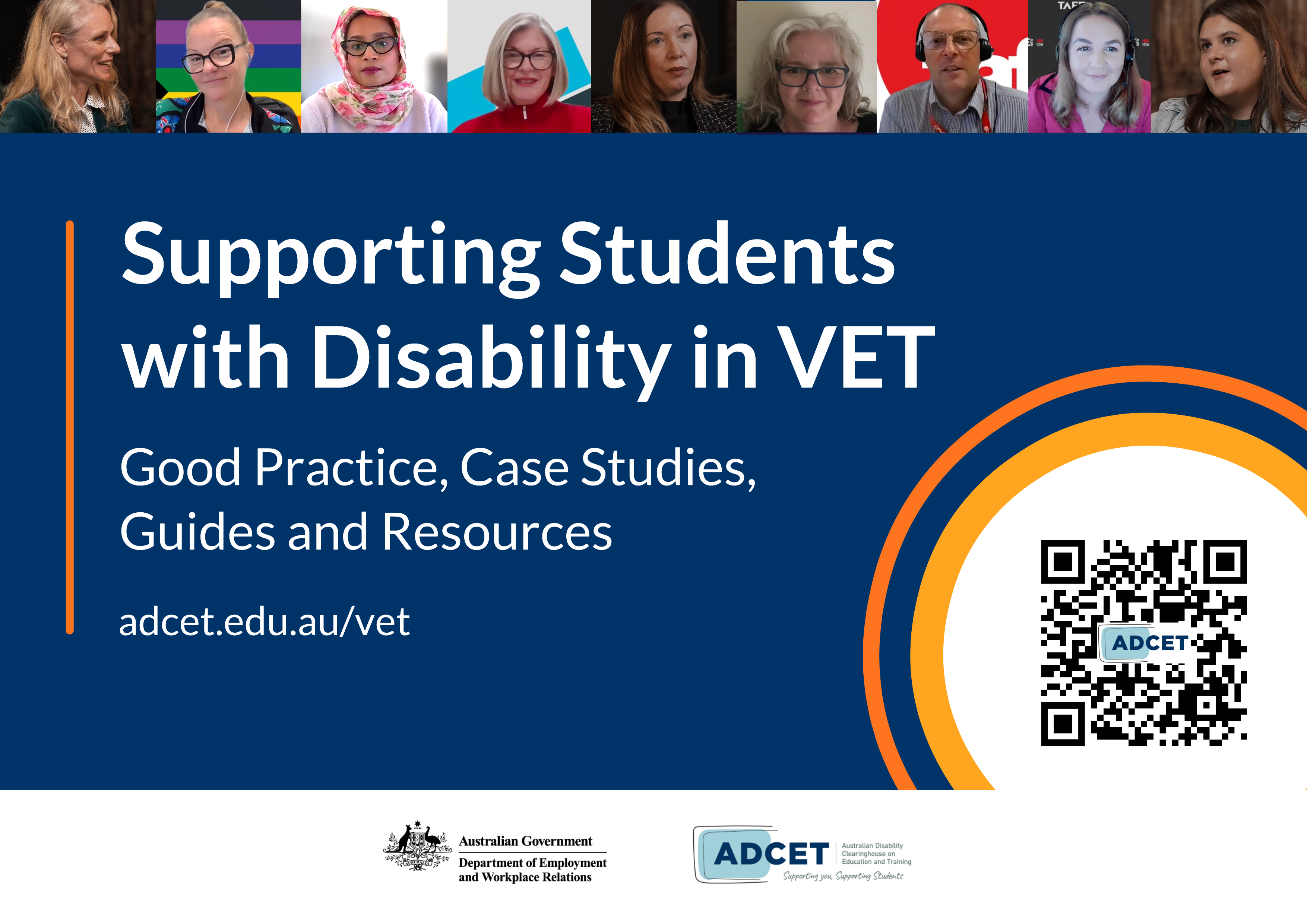
Two posters are available to display in staff areas and to print or distribute electronically for teams. We’ve allowed space for you to add your own organisational logo, if you would like to do that.
Download links:
- Supporting Students with Disability in VET (ADCET Academy)
- Supporting Students with Disability in VET (ADCET Website)
Access to SCORM files
ADCET has made the SCORM files available to RTO’s free of charge so that you can embed, measure, and track completions in your own LMS, if applicable. RTO staff can do the training for free on ADCET Academy, however, access to SCORM files gives RTOs another option for implementation. You can request access to the SCORM files at the ADCET Academy website.
Supporting adoption of the resources
To support the development of skills and practice relating to students with disability in VET, staff should be provided adequate time for professional development on a regular basis. This should include time to:
- complete the relevant eLearning,
- participate in communities of practice or attend relevant webinars
- engage with UDL Studio or ADCET Assist when needing support.
ADCET encourages RTO leadership to:
- Enhance organisational policies to ensure training and professional development on this topic is included in onboarding checklists and annual reviews
- Ask educators and support staff to complete the eLearning program that fits their role and measure uptake and completions.[4]
- Share the staff email and posters to raise awareness across your teams.
- Use the VET data resource to review national trends against your own enrolment, completion and outcomes data for students with disability.
- Use the practice guides, illustrations and case studies to support and compliment your existing strategies and practice.
[1] Data in this guide are drawn from the updated VET Data for Decision Making page on ADCET, https://www.adcet.edu.au/vet/vet-data-for-decision-making
[2] You can access the Standards on the Department of Employment and Workplace Relations website.
[3] Final Report of the 2020 Review of the Disability Standards for Education 2005, Department of Education (released 12 March 2021); also available via ADCET at https://www.adcet.edu.au/resource/10535
[4] This can be achieved either by staff providing you with a certificate of completion from ADCET Academy or through monitoring your own LMS using the SCORM files
(August 2026)